 close window  Gesso
|
 Bob Uses Gesson on Everything Gesso is an acrylic primer. It is applied to canvas prior to painting on it. The purpose of gesso is to seal the cotton or linen canvas, resulting in a solid, hard acrylic surface. The gesso not only protects the fabric from decay, it also provides an excellent bond for the paint to the canvas. Acrylic painters as well as oil painters use gesso on their canvas. Generally, canvases are already pre-gessoed when you purchase them in art materials stores, to save you the time of applying it yourself. Normally gesso is white. There is also black gesso. In fact, Holbein offers eighteen different colored gessos. (Available thru black-horse.com) Holbein's gessos are a very high quality gesso and has a good, hard finish. A more economical gesso is now offered by Cheap Joe's Art Stuff (cheapjoes.com) It's cheap and it works. However, when dried, it has a softer feel. Utrecht has a professional grade gesso that is thick, buttery smooth and dries hard. It is also very economical. (utrecht.com) Try all three brands and decide for yourself which one works the best with your paints. 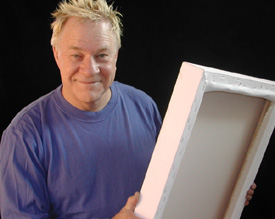 Bob With Pre-Gessoed Canvas I gesso everything. Even the pre-gessoed canvases. It's my way of telling the canvas who's the boss. That perfectly pre-primed, white canvas is now not so intimidating. I have ownership. I also paint on excellent watercolor paper - Fabriano Artistico, cold press, 300 lb. (buy in packs at Cheap Joes!) Gessoing watercolor paper cancels out all the beautiful, absorbent qualities of my good Fabriano paper. It seals it. I paint with acrylic (not watercolors) on my gessoed watercolor paper. The fact that the surface is now nonabsorbent, I have a longer working time with the paint. I can move it around and play with the paint longer. Plus, since the surface is nonabsorbent, when the final coat of varnish is applied, the varnish seals the painting and does not soak into the paper. The question is raised: Why use good watercolor paper if you are canceling its absorbent qualities? Why not use cheap illustration board or a lesser grade paper? Several reasons... I'm a professional. My work is sold in high-end galleries. I'm giving the buyer the best quality product I possibly can. I won't have to worry that the painting will fall apart later on. And besides, I was on the American Board of Advisors in developing Fabriano Artistico. The paper stays flay (even the 140 lb), won't curl up when wet and has no unpleasant aroma, like so many popular papers. How to apply the gesso? I pour it on and squeegee or trowel it around with a piece of cardboard, leaving some of the trowel marks. I like the hand-crafted finish and texture. Now you know!   Bob & Patricia Discussing Gesso |
Copyright ©2008 Robert Burridge. All rights reserved.
If you wish to copy this material to other publications
or mail lists, please ask for permission by contacting:
Robert Burridge Studio
Arroyo Grande, California
805-459-1503
rburridge@robertburridge.com
www.robertburridge.com
close window